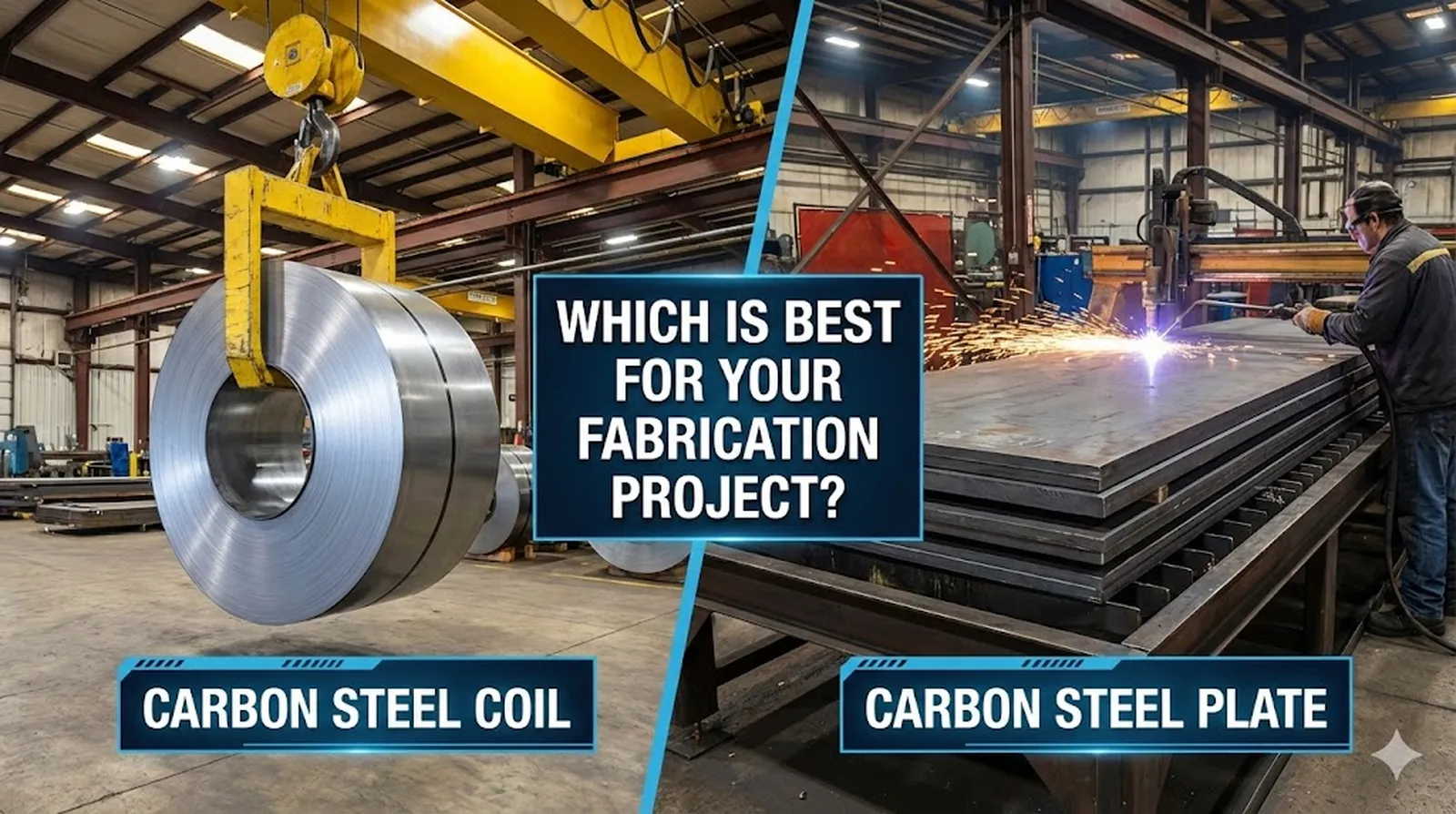
The foundation of any successful metal fabrication project—whether you’re building a towering skyscraper, a complex ship, or a simple enclosure—starts with one critical decision: choosing the right raw material format. Specifically, when working with the versatile and popular material, carbon steel, you must decide between using a continuous coil or a fixed-size plate.
While both are essentially the same material (carbon steel), the way they are manufactured and supplied changes everything about how they are processed, what they can be used for, and how much they cost. Choosing the wrong format can lead to costly material waste, extended production times, and a finished product that doesn’t meet the required standards of strength or durability.
This guide is designed to cut through the technical jargon. We will clearly define what carbon steel coil and carbon steel plate are, explain how their characteristics differ, and, most importantly, provide you with the straightforward knowledge to decide which one is truly best for your specific fabrication project.
🌀 Deep Dive: Understanding Carbon Steel Coil
What is a Carbon Steel Coil?
A coil is exactly what it sounds like: a giant roll of very long, continuous steel ribbon. Carbon steel coils are long strips of steel that have been tightly wound into a large, dense spiral, similar to a massive roll of tape.
How is Carbon Steel Coil Made?
The manufacturing process is continuous. A large slab of steel is progressively flattened by passing it through a series of rollers until it reaches the desired thickness. The steel, still in one long piece, is then wound onto a giant spool.
Coils are further categorized by how they are finished:
- Hot-Rolled (HR) Coil: Processed at very high temperatures. Results in a slightly rougher surface finish (“mill scale”) and is suitable for less critical structural components.
- Cold-Rolled (CR) Coil: Cooled, then rolled again at room temperature. This provides a much smoother, brighter surface finish and tighter dimensions. It is used for thinner and higher-quality applications.
Key Characteristics of Carbon Steel Coil
Coils are typically used to produce lighter gauges of steel, generally under $1/4$ inch ($6 \text{ mm}$). Their continuous length is their greatest advantage, making them perfect for **high-volume, automated manufacturing**. Coils, especially Cold-Rolled, are highly flexible and ideal for complex bending and shaping operations.
Best Uses and Applications
The coil format is ideal for **mass production** and applications that require a thin, formable material:
- Stamping and Deep Drawing: For manufacturing appliance panels, vehicle chassis components, or cookware.
- Tubing and Pipe: Used as the starting material for **welded pipe**.
- Automotive Bodies: Doors, hoods, and fenders often require the clean finish of Cold-Rolled material.
Pros of Coil: Excellent for high volume, continuous processing, better surface finish (CR), easily automated.
Cons of Coil: Limited to thinner materials, less suited for heavy, structural loads.
🛡️ Deep Dive: Understanding Carbon Steel Plate
What is a Carbon Steel Plate?
A plate is a fixed, rectangular piece of very thick steel, like a huge, flat slab. It is defined by its width and fixed length, designed for serious strength and load-bearing capacity.
How is Carbon Steel Plate Made?
The process is designed for thickness and structural integrity. Large slabs are rolled individually (not continuously) until they reach a much thicker gauge than coil, often starting at $3/16$ inch ($5 \text{ mm}$) and going up to several inches thick. Once sized, the plates are cut to fixed, standard dimensions.
Key Characteristics of Carbon Steel Plate
Plate is much thicker and heavier than coil. It provides superior strength and rigidity, making it essential for structures that must withstand massive forces or weight. Plates come in standardized widths and lengths (e.g., $4\text{ ft} \times 8\text{ ft}$ or $8\text{ ft} \times 20\text{ ft}$).
Best Uses and Applications
The inherent thickness and strength of the plate make it mandatory for large-scale, heavy-duty construction and high-stress environments:
- Construction: Structural components for bridges, commercial buildings, and foundations.
- Shipbuilding: Hulls, decks, and structural bulkheads.
- Heavy Machinery: Components for cranes, bulldozers, and mining equipment.
- Pressure Vessels: Boilers, storage tanks, and pipelines that hold high-pressure gas or liquid.
Pros of Plate: Unmatched structural strength, ideal for heavy loads and critical components, available in extreme thicknesses.
Cons of Plate: Less flexible, harder to cut and process, generally higher cost per piece.
⚖️ Direct Comparison: 5 Key Differences for Fabricators
| Feature | Bobine en acier au carbone | Tôle d'acier au carbone |
|---|---|---|
| 1. Thickness & Strength | Thinner (light gauge), high flexibility. | Thicker (heavy gauge), superior structural strength. |
| 2. Production Volume | Ideal for high-volume and automated processing. | Ideal for low-volume, custom, and fixed-size projects. |
| 3. Processing & Cutting | Requires slitting and blanking. Perfect for high-speed stamping. | Requires heavy-duty cutting (plasma, laser, flame). |
| 4. Surface Finish | Can be Cold-Rolled (CR) for a superior, paint-ready surface. | Usually Hot-Rolled with a rougher finish; strength is primary. |
| 5. Material Cost | Generally cheaper per pound in high volume. | Higher material cost due to volume and strength grade. |
Decision Point 1: Thickness and Load
If your project involves extreme weight or critical structural support (like a bridge), you need the **thickness and guaranteed strength** of **Carbon Steel Plate**. If you need thin components that require bending and deep drawing (like a car door), **Carbon Steel Coil** is your choice.
🏗️ Case Studies: When to Choose Which
Choose Plate When…
- Shipyard Construction: Forming the hull and ballast tanks requires material that can withstand water pressure and continuous stress.
- Heavy Equipment: Manufacturing the frame or chassis of an industrial excavator requires steel many inches thick.
Choose Coil When…
- Automotive Stamping: Producing thousands of car doors or hoods requires a continuous supply of thin steel with a perfect finish.
- Steel Service Centers: These companies buy coils and use slitting machines to cut the coil into custom widths or fixed-length flat pieces to meet various customer requirements.
🏁 Conclusion
Choosing between carbon steel coil and carbon steel plate is not about which is “better” overall, but which is **best suited** for your specific requirements.
- If your project demands extreme structural strength, high thickness, and heavy loads, select **Plate**.
- If your project demands high production volume, thinner material, and high formability, select **Coil**.
By accurately assessing your application, budget, and required strength, you can ensure you start your fabrication project with the perfect material choice, saving time and money in the long run. Contact our team today to discuss your exact specifications and ensure you get the right carbon steel product for the job.
“`